
Initiative · AI Delivery Economics
The $15 Engineering Hour
From AI augmentation to an AI-native software delivery model
Generative AI is creating two different economic models for software companies. The first augments the traditional engineering pyramid. The second rebuilds delivery around AI and preserves people only where judgment, context and accountability remain necessary.
The first is conservative augmentation. AI is added around the existing junior–intermediate–senior team. Engineers work faster, but the organizational pyramid remains largely intact.
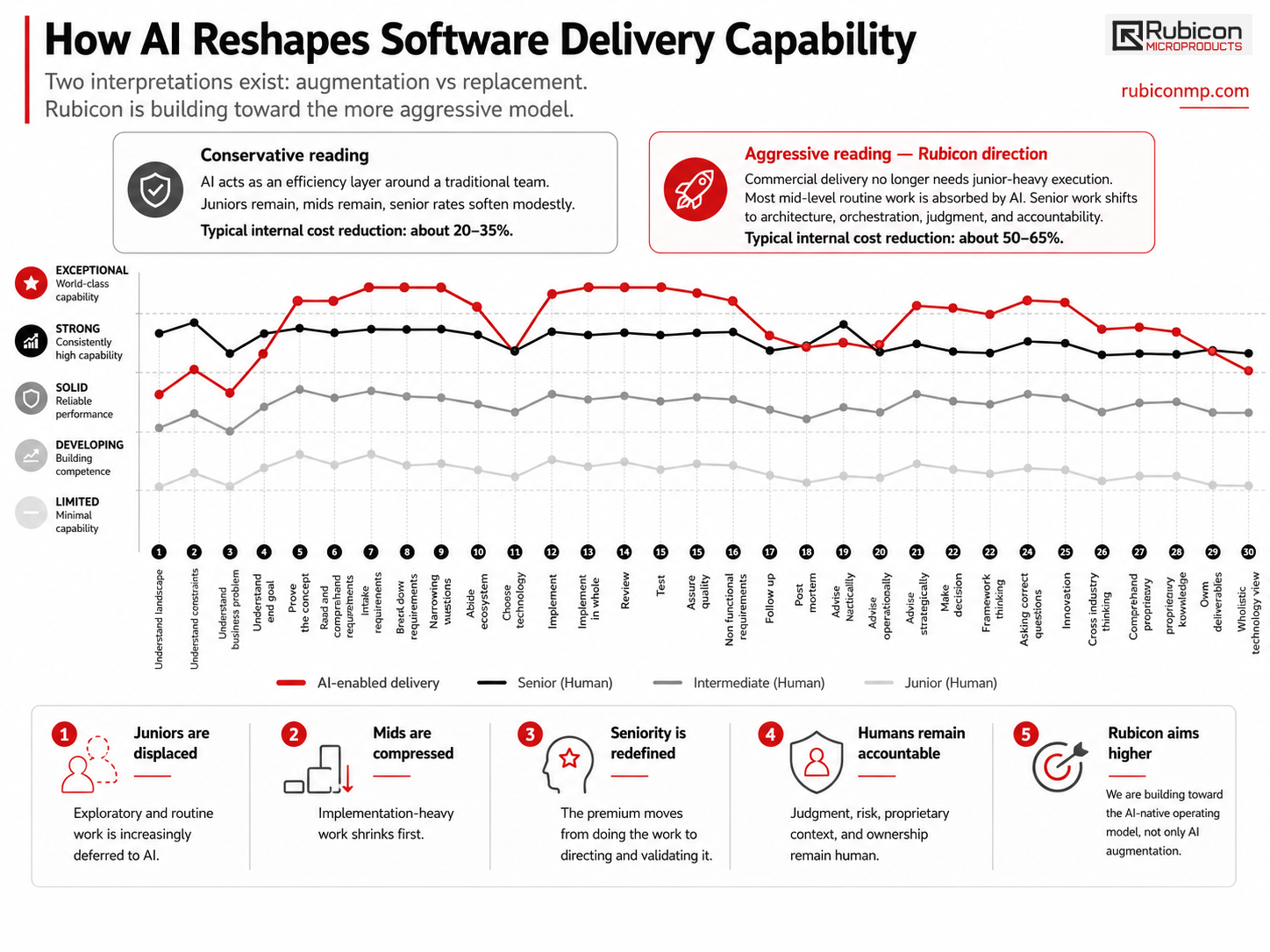
The second is aggressive AI-native delivery. Exploratory, routine and bounded execution work is routed to AI by default. The junior delivery layer largely disappears, the intermediate layer contracts sharply, and fewer senior engineers remain. Human value moves upward into business framing, architecture, orchestration, judgment and accountability.
Both approaches can produce savings. Rubicon Microproducts is building toward the second.
Two approaches to the same disruption
Conservative augmentation
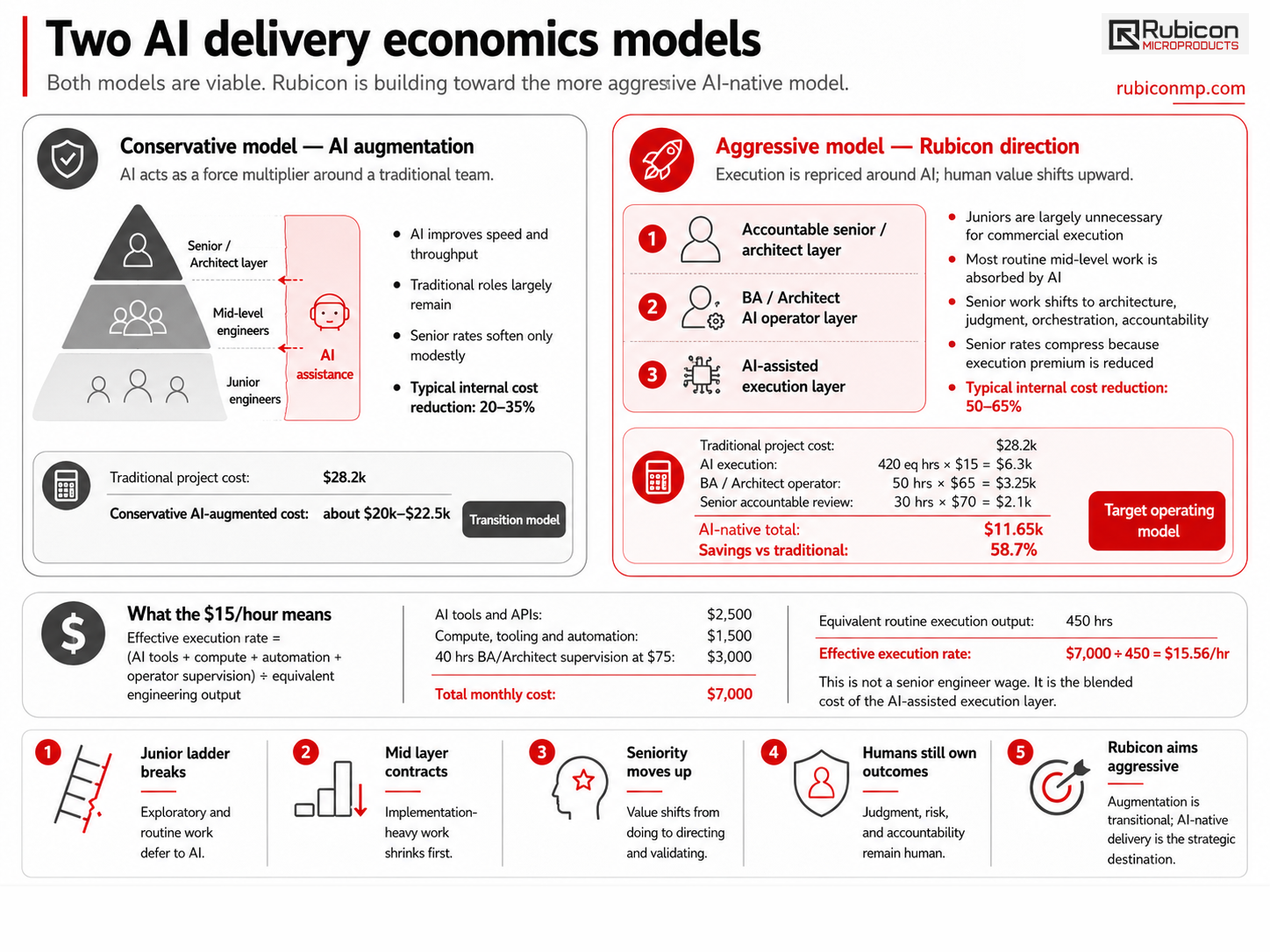
AI acts as a force multiplier around a traditional team. Junior, intermediate and senior roles remain; AI removes selected hours from each layer.
Target reduction: approximately 20–35%Aggressive AI-native delivery
AI becomes the default execution capacity. People remain primarily for orchestration, proprietary context, judgment and ownership.
Target reduction: approximately 50–65%Conservative augmentation
In the conservative model, junior engineers still perform entry-level implementation and support work, intermediate engineers remain the main delivery layer, and senior engineers continue to design, review and resolve difficult issues. AI assists every level with research, code, documentation, tests and troubleshooting.
This model is easier to adopt when automated testing is weak, proprietary knowledge is fragmented, security controls are restrictive, or the organization operates a large and poorly documented legacy estate. Its limitation is economic: the company keeps paying for most of the traditional hierarchy while also paying for AI.
Aggressive AI-native delivery
In the aggressive model, AI is not an assistant assigned to each engineer. It is the default execution capacity. The system separates work into three layers:
- AI-assisted execution: research, comparison, decomposition, coding, refactoring, testing, documentation, data preparation, migration and routine troubleshooting.
- AI orchestration: Business Analysts, Architects and technically capable domain operators provide context, divide work, direct agents, inspect results and control iteration.
- Human accountability: a smaller senior layer owns architecture, risk, security, compliance, production readiness and the final business result.
Rubicon’s position: augmentation is transitional
The conservative model is a practical transition path. It gives organizations time to build tests, encode proprietary knowledge, improve controls and measure where AI is reliable. It should not be mistaken for the destination.
If AI can perform a class of work faster, more consistently and at a fraction of the cost, preserving that work as a human role is not a sustainable business model. Clients will not continue funding hours simply because those hours historically trained junior staff or supported the traditional promotion ladder.
Rubicon is therefore designing toward the more aggressive model:
- exploratory and routine work is deferred to AI;
- implementation-heavy junior work is removed from commercial delivery;
- most intermediate execution is automated or elevated into orchestration;
- senior capacity is reduced and repriced around judgment rather than production;
- every deliverable still has a named human owner.
What moves to AI
Exploration and discovery
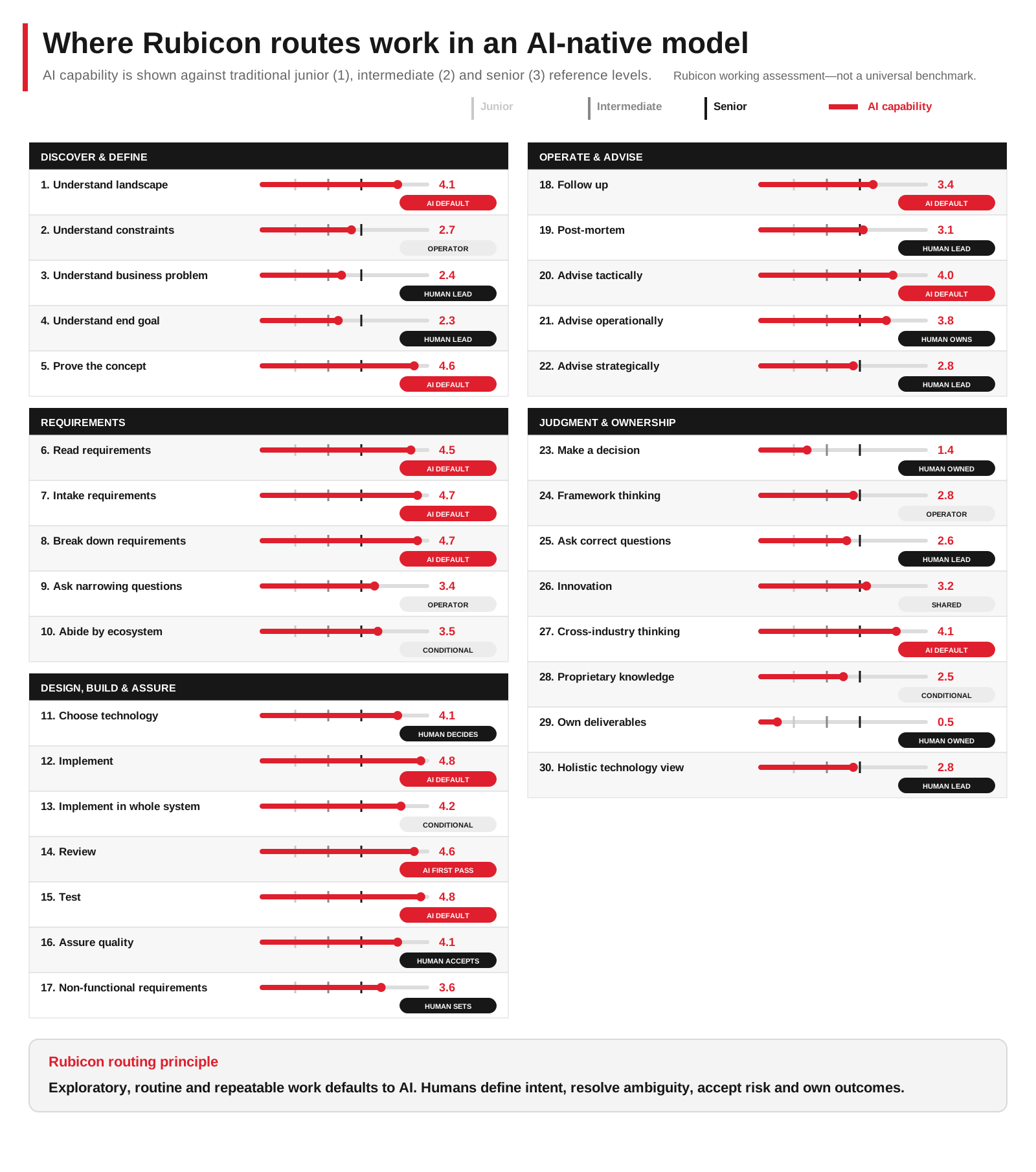
AI can scan unfamiliar technologies, compare platforms, summarize standards, inspect documentation, generate options and produce a first proof of concept. A junior engineer may need days to become oriented; an AI system can produce a broad initial map in minutes. The human role is to identify what matters and expose hidden constraints.
Requirements processing
AI can read large requirements sets, compare versions, extract entities and rules, identify contradictions, propose acceptance criteria and generate traceability. A BA or Architect remains important primarily as the operator who asks the correct narrowing questions and resolves ambiguity.
Implementation
Bounded coding, refactoring, integration scaffolding, data transformation, configuration, migration scripts and repetitive feature work are natural AI execution tasks. The real requirement is an environment that can evaluate generated output automatically.
Testing, documentation and operations
AI can generate test cases, expand boundary coverage, create fixtures, analyze failures, draft technical documentation, produce release notes and assemble incident timelines. Humans own commitments and consequences; AI performs much of the preparation.
What happens to engineering roles
Junior engineers: the commercial apprenticeship layer disappears
In the aggressive model, software delivery no longer requires a large junior layer. The work traditionally assigned to juniors-research, boilerplate code, first-pass implementation, basic tests, documentation, routine analysis and exploratory troubleshooting-is precisely where AI has the strongest cost and speed advantage.
This creates a real workforce-development problem, but it is separate from project economics. New engineers will need structured labs, simulated projects, open-source work, supervised rotations and product experiments rather than relying on clients to fund inefficient project work as training.
Intermediate engineers: the layer contracts sharply
The intermediate layer historically converted requirements into implementation with moderate supervision. AI increasingly performs that conversion directly. Intermediate engineers remain valuable when they possess deep proprietary knowledge, operational ownership, difficult integration experience or regulated-domain expertise. Generic implementation capacity is no longer enough.
Senior engineers: fewer hours and a different premium
Senior engineers remain, but their execution premium compresses. AI increasingly commoditizes faster research, stronger coding and the ability to avoid routine implementation mistakes.
The remaining premium is attached to framing the real problem, choosing architecture, recognizing dangerous output, resolving ambiguity, understanding proprietary context, accepting risk and owning the result. A senior who mainly writes code will face rate pressure. A senior who can direct AI and accept accountability remains essential-but fewer are required per unit of output.
Business Analysts and Architects: the force-multiplier layer
A strong BA or Architect can direct several AI workflows concurrently: analysis, design alternatives, implementation, tests, documentation and review. Their value comes from context, decomposition, evaluation and the ability to ask the correct question. This is not conventional prompt writing; it is operating a software production system.
The economics
Consider a project that traditionally requires 500 human engineering hours.
Traditional
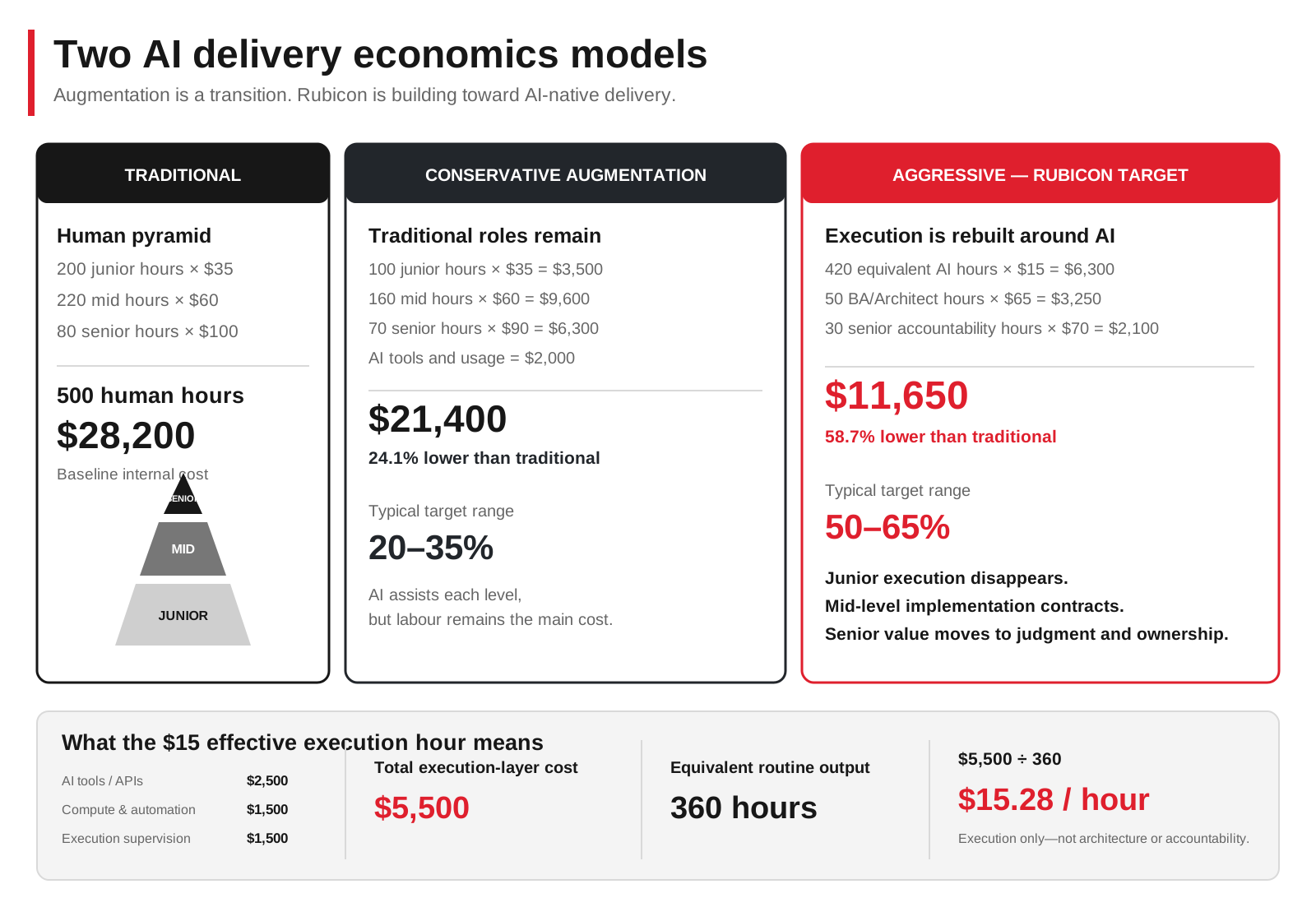
| 200 junior hours × $35 | $7,000 |
| 220 mid hours × $60 | $13,200 |
| 80 senior hours × $100 | $8,000 |
| Total | $28,200 |
Conservative
| 100 junior hours × $35 | $3,500 |
| 160 mid hours × $60 | $9,600 |
| 70 senior hours × $90 | $6,300 |
| AI tools and usage | $2,000 |
| Total | $21,400 |
24.1% reduction
Aggressive Rubicon model
| 420 AI-equivalent hours × $15 | $6,300 |
| 50 BA/Architect hours × $65 | $3,250 |
| 30 senior accountability hours × $70 | $2,100 |
| Total | $11,650 |
58.7% reduction
What the $15 rate means
The $15 figure represents the effective cost of the AI execution layer. An illustrative monthly calculation is:
| Execution-layer cost | Monthly amount |
|---|---|
| AI subscriptions and APIs | $2,500 |
| Compute, development tooling and automation | $1,500 |
| Execution supervision: 20 hours at $75 | $1,500 |
| Total execution-layer cost | $5,500 |
Project-level BA/Architect orchestration and senior accountability are calculated separately. The $15 rate includes routine interaction needed to keep the execution system moving; it does not include architecture, stakeholder decisions or acceptance of business risk.
Where the aggressive model does not apply immediately
A conservative approach may remain necessary where the business problem is ambiguous, proprietary knowledge is inaccessible, automated acceptance is weak, failure carries material safety or legal risk, or the system depends heavily on undocumented tacit knowledge.
These are not permanent exemptions. They identify the infrastructure and governance that must be built before execution can move safely.
Building the aggressive model
Encode the environment
Architecture rules, coding conventions, business terminology, data models, security constraints and integration patterns must be available in forms AI can consume.
Make quality executable
Tests, linters, security scanners, policy checks and acceptance criteria must reject weak output automatically. Senior people should review exceptions and material decisions, not every generated line.
Separate execution from ownership
AI may produce the artifact, but a named human must own its release and consequences.
Measure equivalent output
Relevant metrics include human hours displaced, review burden, defect escape rate, cycle time, rework and senior attention consumed.
Reprice roles honestly
Routine execution should not carry a senior premium merely because a senior person initiated the prompt. Premium rates belong to architecture, judgment, proprietary knowledge and accepted responsibility.
The new economy for software companies
The conservative company keeps its hierarchy and makes each person faster. The aggressive company asks why the hierarchy is still required.
Rubicon is building toward the aggressive answer: a small accountable human layer, a high-leverage BA/Architect operator layer, and an inexpensive AI execution layer underneath.